
HOME
INTRO
SYMBOLS
ALMANAC
ECONOMY
GEOGRAPHY
STATE MAPS
PEOPLE
FORUM
NEWS
COOL SCHOOLS
STATE QUIZ
STATE LINKS
BOOK STORE
MARKETPLACE
GUESTBOOK
CONTACT US



The State of New Jersey
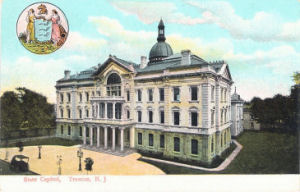
New Jersey Capitol Building, Trenton

Welcome to New Jersey. New Jersey ratified the U.S. Constitution in 1787 becoming the third state to do so, and was the first state to ratify the Bill of Rights in 1789.
New Jersey is an aggressively industrial state, and has been throughout U.S. history. As far back as 1791, when Alexander Hamilton chose the Great Falls of the Passaic River as the site of a model factory town, industry began to shape the state. Then, throughout the 19th century, New Jersey saw transportation feed industry, as canals, railroads, roads, and ports were built. And on into the 20th century, as its highway and transportation systems improved, it has continued to reign as one of the leading industrial states in the country.
THE STATE NAME:
Sir John Berkley and Sir George Carteret received a royal charter for a colony in the new land and named this colony for the island of Jersey in the English Channel. Carteret had been born on Jersey and had spent several years as Lieutenant Governor of the island.
THE STATE NICKNAMES:
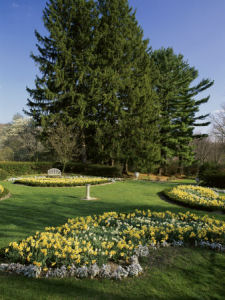
New Jersey Botanical Garden
Ringwood State Park
The Garden State
This nickname seems to have originated at the Centennial Exhibition in Philadelphia on Jersey Day, August 24, 1876. Alfred M. Heston states in his 1926 work, Jersey Waggon Jaunts, that "The Garden State" was used by Abraham Browning, of Camden. "In his address Mr. Browning compared New Jersey to an immense barrel, filled with good things to eat and open at both ends, with Pennsylvanians grabbing from one end and the New Yorkers from the other. He called New Jersey the Garden State, and the name has clung to it ever since."
In later years, the explanation has evolved to reference New Jersey truck farms that provide floral and agricultural produce to cities in the area instead of an "immense barrel." These farms have catered, particularly, to the New York and Philadelphia metropolitan areas. Some support the nickname with stories of the Revolutionary War and the food provided to soldiers by the small farms of New Jersey.
Probably the most intense promotion of this nickname for New Jersey began when the legislature voted to add the legend "Garden State" to New Jersey license plates in 1954, in spite of the Governor's refusal to sign the bill, in part because "New Jersey is noted for its great strides in manufacturing, mining, commerce, construction, power, transportation, shipping, merchandising, fishing and recreation, as well as in agriculture. I do not believe that the average citizen of New Jersey regards his state as more peculiarly identifiable with gardening for farming than any of its other industries or occupations."
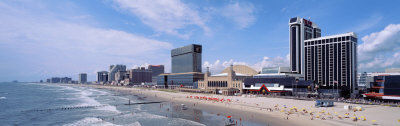
Atlantic City, New Jersey
The Clam State
This nickname refers to the clams taken off the coast and in the Delaware Bay. New Jersey is bordered by the Atlantic Ocean on the east.
The Camden & Amboy State
or "The State of Camden and Amboy" is a reference to the old Camden and Amboy railroad and highlights the powerful influence of this railroad in the state.
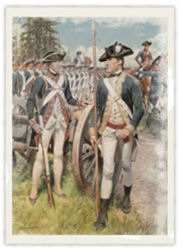
Revolutionary War Uniforms
Courtesy: United States Army
The Jersey Blue State
This historical nickname recalls the blue uniforms of the New Jersey Revolutionary War soldiers.
The Pathway of Revolution
Another nickname recalling the Revolutionary War period, "The Pathway of Revolution" is a reference to the battles fought on New Jersey soil during the war.
The Switzerland of America
New Jersey, like other states with mountainous areas, has been referred to as "The Switzerland of America." This reference, made by early settlers, was to the western part of the state and the Kittatinny range and to the Watchung, Sourland and Pickle mountains in the southeast. Perhaps the most famous are the Palisades along the Hudson River.
The Mosquito State
New Jersey has sometimes been referred to as "The Mosquito State" obviously in reference to the irritating, bloodthirsty little insects. New Jersey really does not have more of these insects than other states, and it is not clear how this appellation originated.
New Spain
or "The State of Spain" came about when Joseph Bonaparte, the King of Spain, fled to New Jersey around 1812. He bought about 1,400 acres of land in the state and built a "palatial mansion" where he entertained foreign dignitaries until 1822. It's rumored that Philadelphians were jealous of New Jersey's good fortune to have such an illustrious resident and they referred to New Jersey, humorously, as "New Spain" or "The State of Spain."
The Foreigner State
In the same vein as "New Spain," this nickname evolved from the humorous gibe to New Jersey, that it was a foreign land filled with foreigners under the social influence of the previous King of Spain. New Jersey was sometimes referred to as "The Foreign State."
THE STATE CITIZENS:
People who live in New Jersey or who come from New Jersey are called New Jerseyites or New Jerseyans.
THE STATE QUARTER:
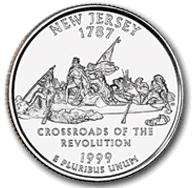
United States Mint Image
On December 18, 1787, New Jersey became the third state to ratify the Constitution of the United States and join in this great union. The New Jersey state quarter was the third of the five quarters minted in 1999. The scene is the familiar "Washington Crossing the Delaware" and is based on an 1851 painting by Emmanuel Leutze."
New Jersey's location put it at the heart of many famous Revolutionary battles. It was before the Battle of Trenton that George Washington made his famous surprise crossing of the Delaware on Christmas night to defeat the Hessian army.
For more about the state commemorative quarters, visit this page.
This 50 State Quarter Map is a great way to collect and display all 50 State Quarters.
Sources...
Shankle, George Earlie. State Names, Flags, Seals, Songs, Birds, Flowers, and Other Symbols. Irvine, Calif.: Reprint Services Corp, Revised edition, 1971.
Shearer, Benjamin F. and Barbara S. State Names, Seals, Flags and Symbols: A Historical Guide Third Edition, Revised and Expanded. Westport, Conn: Greenwood Press, 3 Sub edition, 2001.
Additional Information
New Jersey
Elizabeth J. Scholl
New Jersey (From Sea to Shining Sea), by Elizabeth J. Scholl. 80 pages. Publisher: Scholastic Library Publishing (September 2002) Reading level: Grades 3-5. Presents information about New Jersey's people, geography, history, landmarks, natural resources, government, state capitol, towns and cities, and more.
New Jersey
Eric Siegfried Holtz
New Jersey (World Almanac Library of the States), by Eric Siegfried Holtz. 48 pages. Gareth Stevens Publishing (October 2002) Reading level: Grades 4-6. Filled with the most up-to-date information, including the latest Census results. Full-color photos bring to life the story of New Jersey. In addition to an in-depth factual profile of New Jersey in the form of a state Almanac, this book offers fascinating and lively discussions of the state's history, people, geography, government, economy, culture, and lifestyles. A section on Notable People, a calendar of events, and enough primary source documents, time lines, maps, and other tools to make this unquestionably the best young adult reference material on the USA available anywhere.
Encyclopedia
of New Jersey
Encyclopedia of New Jersey, edited by Maxine Lurie, Marc Mappen. 912 pages. Publisher: Rutgers University Press; 1 edition (March 25, 2004) The Encyclopedia of New Jersey is the most extensive reference work ever published on the Garden State. The Encyclopedia contains nearly 3,000 original articles, along with 585 illustrations and 130 maps, collecting a wealth of information about the state in one volume. The Encyclopedia is filled with fascinating and interesting entries ranging from New Jersey's earliest history to the present. For example-Did you know that New Jersey was once divided into two parts-East Jersey and West Jersey? That streptomycin was first isolated at Rutgers University? Or that the first vote cast by an African American under the Fifteenth Amendment was in Perth Amboy? How about that New Jersey was the site of the first intercollegiate football game? These facts, and thousands more, can be found in the pages of the Encyclopedia of New Jersey. This volume will provide the answers to questions about New Jersey that you never even knew you had.
The History
of New Jersey
The history of New Jersey from its earliest settlement to the present time., Ed. by W. H. Carpenter and T. S. Arthur. 302 pages. Publisher: Scholarly Publishing Office, University of Michigan Library (December 20, 2005) This volume is produced from digital images created through the University of Michigan University Library's preservation reformatting program.
New Jersey
A History
New Jersey: A History, by Thomas J. Flemming. 244 pages. Publisher: W. W. Norton & Company (October 1, 1985) An historical guide prepared by the editors of the American Association for State and Local History.
When members of the colonial assembly warned Governor Philip Carteret in 1668 that he should abandon any expectations "that things must go according to your opinions," they struck a keynote for the New Jersey experience and suggested to author Thomas Fleming what perhaps should have been the state's motto: "Divided We Stand."
"Division, acrimony, and their children, riot and revolution" have marked New Jersey life from early quarrels between proprietary rulers and local residents to recent combat over a state income tax. Few other states are as closely identified with corruption in political life and the deliberate confusion of public good with private profit. New Jersey offers a case study of a small state whose citizens, locked between the two giants of New York and Pennsylvania and too often moved by ideals no loftier than "devil take the hindmost," largely failed to develop a compelling sense of community and purpose.
Not all New Jersey's past is so unsavory. Ethnic diversity made it an early testing ground for the melting pot, as Yankees, Irish, Italians, and blacks strove for a chance at the good life. To many, that meant a job in the factories that made the state an industrial pioneer; to others it meant life on the farms that made New Jersey truly the "Garden State." Mr. Fleming concludes that today New Jersey may be in the vanguard of a new American way of life, "the first metropolitan state with equally convenient access to cities and to countryside." He foresees an "equally-oriented New Jersey, honestly and efficiently governed," reminding the nation that divisiveness and acrimony can have more than one outcome. After all, New Jerseyites may have voted repeatedly for the "Boss of Bosses," Frank Hague, but they also once chose as their governor a Princeton professor named Woodrow Wilson.


