
HOME
INTRO
SYMBOLS
ALMANAC
ECONOMY
GEOGRAPHY
STATE MAPS
PEOPLE
FORUM
NEWS
COOL SCHOOLS
STATE QUIZ
STATE LINKS
BOOK STORE
MARKETPLACE
GUESTBOOK
CONTACT US


You may double left-click on a word on this page to retrieve its definition. Tweet Follow

Tennessee State Wild Flower
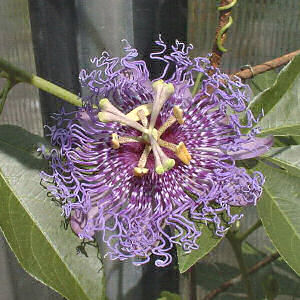
Tennessee State Wild Flower: Passion Flower
Photographs, posters, prints
Tennessee began the process of selecting an official flower when it realized that it was one of only ten states without this official representative.
At the request of Governor Thomas Clarke Rye, State Senator Andrew Todd and State Representative Seth Walker sponsored legislation that would establish a mechanism by which a state flower could be selected.
On January 13, 1919, the Sixty-first General Assembly of Tennessee adopted Senate Joint Resolution No. 13 (SJR13). The legislation read, in part,
That the Governor of the State be authorized and requested to name a commission of five distinguished citizens of the State, who shall serve without compensation, which commission shall be headed by the State Superintendent of Public Instruction, to name a date on which the school children of the State may have the right and opportunity of voting on a State flower for the State of Tennessee,...
Additionally, SJR13 went on to say,
That the flower which shall be named by the school children and certified by the commission shall be recognized as the State flower.

John Trotwood Moore
Tennessee State Library and Archives.
Copyright © by the Tennessee Historical
Society and The University of Tennessee
Press. All rights reserved.
Favorites of the children around the state listed in the Nashville Banner included the daisy, elder bloom, goldenrod, red clover, rose, sunflower, water lily, wild rose, and violet. The passion flower was not even listed in this January 26, 1919 article.
Counting the votes was left to the commission that had been selected by the Governor. When the counting was over, the commission certified the passion flower the winner.
The results were published in newspapers and a pamphlet was created to celebrate the occasion. Put together by State Librarian and Archivist John Trotwood Moore, 10,000 copies of Tennessee: State Flag-Flower-Song-Seal and Capitol were printed and distributed.
Mr. Moore even wrote a poem for the passion flower, which he called a "most fitting" selection. The poem was published in Tennessee: State Flag-Flower-Song-Seal and Capitol with an introduction:
This beautiful flower, called by the early Spaniards the Passion Flower [sic], and by our own pioneers the May-Pop and Wild Apricot, was abundant all over Tennessee. The Cherokee Indians called it the Ocoee; hence the Ocoee valley and river; and they prized it as their most abundant and beautiful of all flowers. It is, therefore, most fitting that this flower be adopted as the State Flower.
Ocoee
Oco-ee, Oco-ee, Oco-ee,
The Indian maiden sang.
"Oco-ee, Oco-ee, Oco-ee,"
The echoing mountains rang:
"Give me thy blooms, Oco-ee,
Give me thy flowers rare,
Thy twilight blue of sunset hue
To bind my mourning hair.
Give me thy gems, Oco-ee,
Thy turquoise crown unfold,
Beset with bars of yellow stars
On calyxes of gold.
Oco-ee, once my bridal flower--
(Now widowed, thou shalt be,)
My warrior comes not home again,
He comes not home to me,
Oco-ee.

Oco-ee, Oco-ee, Oco-ee,
'Twas here he won my love,
Your flowers were my bridal bed
Blue as the skies above
Blue as the skies above
But oh, alas! he lies
Unburied in an unknown land
Beneath its unknown skies.
Thy gems are tears, Oco-ee,
(Ay, yellow tear forlorn!)
Thy blue is turned to ruth and rue
Thy turquoise crown is thorn.
Farewell, my land, my life, my love,
Farewell, oh flower of woe,
My warrior comes not home to me
But I to him will go,
Oco-ee.
Another state flower
Fast-forward 11 years to 1930.
In the early 1930s, flower gardening was gaining popularity in the state. Along with the increased interest in flower gardening came garden clubs and along with garden clubs came appreciation and fascination with the iris, a flower that had been cultivated for thousands of years.
The Nashville Iris Association, established in 1931, gained national and even international attention for its efforts in breeding and growing irises. Nashville became known as the Iris City.
With the growth of the garden clubs, the dissatisfaction with the passion flower as a representative of the state grew as well and the iris was promoted to become Tennessee's official state flower. Iris supporters claimed that the passion flower had never been officially adopted. Soon, the Tennessee Legislature joined in the promotion.
With Senate Joint Resolution No. 53, approved on April 19, 1933, the iris (genus Iridaceae) was adopted as the "State flower of Tennessee." The resolution read, in part
WHEREAS, The State of Tennessee has never adopted a State Flower; and,
WHEREAS, the Iris is one of the most beautiful and one of the most popular flowers in the State, its profusion and beauty attracting many visitors to the State, now, therefore,
BE IT RESOLVED BY THE SIXTY-EIGHTH GENERAL ASSEMBLY OF THE STATE OF TENNESSEE, THE SENATE AND HOUSE CONCURRING, that the Iris be adopted as the state flower of Tennessee.

Tennessee State Librarian and Archivist
Mary Daniel Moore
Tennessee State Library and Archives.
Copyright © by the Tennessee Historical
Society and The University of Tennessee
Press. All rights reserved.
Adoption of the passion flower in 1919 was entirely forgotten or ignored. Joint Resolution No. 53 admitted no knowledge of the previous resolution adopting the passion flower that had been selected by the school children of the state.
Tennessee had now designated two state flowers as representative of the state..
Tennessee State Librarian and Archivist John Trotwood Moore, who had penned the poem, Ocoee, to honor adoption of the passion flower in 1919, died in May 1929. His wife, Mary Daniel Moore, who had worked with him for many years, took over his position as State Librarian and Archivist. In a letter, dated December 4, 1933, she wrote.
The people have been so interested, and at the same time confused, as to which really is the flower or whether or not both are not the State Flower, that I requested the Attorney General's opinion on the subject that I might be able to give an intelligent answer to the many questions that were coming to my desk from the school children, teachers, women's garden clubs, etc. His decision is that the new law repeals the former law and the Iris is now the State Flower.
(Shankle, State Names, Flags, Seals, Songs, Birds, Flowers, and Other Symbols, 1971)
We, at NETSTATE, have seen state symbols and emblems designated by acts of law, resolutions, and by proclamation. We consider and referred to all of these designations as "official." Without getting into a discussion of the relative merits of each of these processes, we simply take the position that all such "official" activity remains valid unless it is specifically repealed or rescinded. There is no firm, universally accepted definition of "official" in these matters.
NETSTATE takes the position that, at that moment in time, Tennessee had two "official" state flowers.
But, of course the passion flower is now considered an official state wild flower and so, as one might guess, the passion flower's story continues. We will see that the Attorney General's legal opinion does not hold much weight when it comes to popular opinion.
War of the state flowers
When the resolution adopting the iris, approved on April 19, 1933, was publicized, there was an uproar. The passion flower, adopted 14 years earlier, in 1919, had not been forgotten. Garden clubs, botanists, and newspapers across the state all had something to say.
We have all heard about the 'war of the roses,' but now it is our duty to give the latest communiqués from the war of the iris and the passionflower....It is reported now that the iris adherents only lift their eyebrows when the passionflower is mentioned, and bad blood is known to exist between the factions representing the two State flowers.
(Chattanooga News)
"The iris, beautiful as it is, is too much a citizen of the world to be called the Tennessee state flower. And there are so many varieties of it you wonder which is ours.
The Legislature did much better in its choice of a state bird [the mockingbird] by allowing the people of the state to express their preference. Since the Legislature unceremoniously 'kicked out' the passionflower, why shouldn't it reopen the matter at the next session and let the people vote?"
(Knoxville News-Sentinel)
For years the conflict raged... Four years later in 1939...
Garden club presidents from various parts of the state, meeting in Chattanooga recently, adopted a resolution favoring the passion flower as Tennessee's State flower.
We are glad that the Garden Clubs recognize that the State Legislature of seventeen years ago had better taste in State flowers than the legislature of five years ago.
(Chattanooga News)
About six months later however, the position of the garden club presidents reached in Chattanooga was reversed at a Tennessee Garden Clubs convention.
As passions ebbed and time marched on, the iris gained in stature as Tennessee's official state flower and the passion flower was relegated to history as the state's first official state flower.
In 1935, "When It's Iris Time in Tennessee," by Willa Mae Waid was adopted as Tennessee's second official state song. In 1949, headlines were made when Governor Gordon Browning provided purple automobiles (honoring the iris) to the nation's other 47 governors at a National Governor's Conference.
Passion Flower not forgotten in 1973
Fifty-four years had passed since the passion flower had been chosen by Tennessee's school children to represent their state. For forty years the passion flower had been eclipsed by the iris.
In 1973, the issue of a state flower made headlines again, brought up again by State Senator Edward Blank. According to Sen. Blank, he was urged to introduce legislation to make the iris the state's official cultivated flower and the passion flower the state's official wild flower. He said, "The people of the good garden clubs across the state would like this resolved."
Perhaps the most influential urging came from his mother, Mrs. Fred L. Blank, who was an active member of the Hampton Garden Club and the Tennessee Federation of Garden Clubs.
In 1973, to finally put an end to the "war of the state flowers" and to eliminate confusion, the 88th General Assembly designated the passion flower the state wild flower and the iris the state cultivated flower.
This is how this official state wild flower is desribed in the Tennessee Blue Book 2013-2014:
The passion flower, genus Passiflora, was designated the official state wildflower in 1973 by Public Chapter 16. The flower grows wild in the southern part of the United States and in South America, and is also commonly known as the maypop, the wild apricot, and the ocoee. The last is the Indian name that has also been applied to the Ocoee River and valley. The Indians prized the ocoee as the most abundant and beautiful of all their flowers. The passion flower received its name from the early Christian missionaries to South America, who saw in the various parts of the curiously constructed flower symbols of the Crucifixion—the three crosses, the crown of thorns, nails, and cords.
(Tennessee Blue Book)
Though this legislation seemed to satisfy Tennesseans for the most part, new generations tend to follow the previous and new passions tend to replace the forgotten. In 2012, Tennessee was back in the official state flower business designating a second state wild flower.
All of Tennessee's state flowers are listed here with a timeline illustrating their shifting titles.
Tennessee Law

Tennessee State Wild Flower: Passion Flower
Photographs, posters, prints
The following information was excerpted from the Tennessee Code, Title 4, Chapter 1, Part 3, Section 4-1-306.
TITLE 4. STATE GOVERNMENT
CHAPTER 1. GENERAL PROVISIONS
PART 3. STATE SYMBOLS
SECTION 4-1-306
4-1-306. State wild flowers.
The official wild flowers of this state shall be as follows:
(1) The passion flower, family passiflora incarnate; and
(2) Tennessee Echinacea, Echinacea tennesseensis.
HISTORY:Acts 1973, ch. 16, § 1; T.C.A., § 4-117; Acts 2012, ch. 829, § 1.
Sources...
Blomstrom, David W. "State Cultivated Flower." Geobopological Survey. Web. 25 Sept. 2011.
Shankle, George Earlie. State Names, Flags, Seals, Songs, Birds, Flowers, and Other Symbols. Irvine, Calif.: Reprint Services Corp, Revised edition, 1971.
Shearer, Benjamin F. and Barbara S. State Names, Seals, Flags and Symbols: A Historical Guide Third Edition, Revised and Expanded. Westport, Conn: Greenwood Press, 3 Sub edition, 2001.
Simbeck, Rob. Tennessee State Symbols. Second ed. Knoxville: U of Tennessee, 2002. Print.
"Tenn. Code Ann. § 4-1-306 (2015)." Tennessee Code Unannotated. LexisNexis, a Division of Reed Elsevier Inc. Web. 17 Mar. 2016.
Tennessee Blue Book. 2013-2014. Tennessee Secretary of State. Department of State Division of Publications. Web. 17 Mar. 2016.
Additional Information

Tennessee State Wild Flower: Passion Flower
Photographs, posters, prints
Passiflora incarnata: Lady Bird Johnson Wildflower Center, Austin. Texas.
Passiflora incarnata L. (purple passionflower): USDA, NRCS. 2004. The PLANTS Database, Version 3.5 (http://plants.usda.gov). National Plant Data Center, Baton Rouge, LA 70874-4490 USA.
Official website: Tennessee Native Plant Society.
Passionflower Herb Uses and Medicinal Properties: Alternative Nature Herbals.
State wildflowers: Complete list of official state wildflowrs from NETSTATE.COM
More symbols & emblems: Complete list of official Tennessee state symbols from NETSTATE.COM.

Wildflowers of Tennessee,
the Ohio Valley and
the Southern Appalachians
Dennis Horn
Tavia Cathcart
Thomas E. Hemmerly
Wildflowers of Tennessee, the Ohio Valley and the Southern Appalachians, by Dennis Horn, Tavia Cathcart, Thomas E. Hemmerly. 496 pages. Publisher: Lone Pine Publishing; 2nd Edition (May 6, 2012)
This is the most complete, comprehensive and informative field guide ever published on the flora of this region. Sponsored by the Tennessee Native Plant Society, this labor of love has been 14 years in the making. The result is a landmark achievement that brings the beauty and uniqueness of wildflowers to amateurs and experts alike. The focus is on Tennessee, but the Ohio Valley and Southern Appalachians are covered, encompassing all or parts of Alabama, Arkansas, Georgia, Illinois, Indiana, Kentucky, Maryland, Mississippi, Missouri, North and South Carolina, Ohio, Pennsylvania, Virginia, and West Virginia. 800 color photographs, 96 line drawings, 3 full-color state and region maps.
Wildflowers of Tennessee
Jack B. Carman
Wildflowers of Tennessee, by Jack B. Carman. 427 pages. Publisher: Highland Rim Press; 1st Edition (2001)
More than 780 color photographs are included in <çite>Wildflowers of Tennessee, more than in any similar work portraying a state’s flora. Additional species mentioned in the text prove useful in identifying over 1100 of the state’s vascular plants and a majority of the showier non-woody plants. Species descriptions are organized consistently for reference and comparison. Families are arranged phylogenetically and genera within families and species are arranged alphabetically.
Gardening With The
Native Plants Of Tennessee
Margie Hunter
Gardening With The Native Plants Of Tennessee: The Spirit Of Place, by Margie Hunter. 99 pages. Publisher: University of Tennessee Press; 1st Edition (October 31, 2002)
In Gardening with the Native Plants of Tennessee, Margie Hunter gives gardeners the knowledge they need in order to nurture this natural heritage in their own gardens. Beginning with a survey of the state’s ecology—including geology, geography, plant life and animal species—Hunter takes a holistic approach to the process of gardening with native plants. The book’s main section provides detailed accounts of 450 species of wildflowers, ferns, grasses, vines, shrubs, and trees native to Tennessee and adjacent states. These descriptions, arranged according to plant type, include both scientific and common name, flowering and fruiting times, propagation methods, soil and light requirements, and distribution patterns within the state. Nearly 400 color photographs illustrate the species discussions.
No other book designed for the home gardener includes such area-specific information on native species or such a comprehensive listing of plants. Appendixes refer readers to other sources of information and seeds, including mail-order nurseries, botanical gardens, state agencies, native plant organizations, and subject-specific conferences. A detailed bibliography also contributes to the reference value of this book for gardeners, landscapers, and nature lovers throughout Tennessee and in neighboring states.
State Botanical Symbols
Alan McPherson
State Botanical Symbols, by Alan McPherson. 132 pages. AuthorHouse (June 10, 2013)
Alan McPherson is a naturalist who resides in northern Indiana and enjoys traveling and learning about the botanical resources our vast country.
In this reference book over 200 state botanical symbols are presented with informative text that highlights their adoptive legislation, botanical and social history. From the white pine of Maine's northeastern forests, westward to the yellow hibiscus of Hawaii's Polynesian islands, our state's official botanical symbols are as uniquely diverse as the terrain and character of the 50 states themselves.
State Birds and Flowers
Coloring Book

U.S. State Flowers
in Counted Cross Stitch
Gerda Bengtsson
State Birds and Flowers Coloring Book
51 accurately detailed, copyright-free renderings include national bird (eagle) and flower (rose) plus 50 state birds and flowers.
U. S. State Flowers in Cross Stitch
Quilting Flowers of the States
Plants, Seeds & Flowers


