|
United States Constitution
National Archives |
STATEHOOD:In 1620, the Pilgrims, seeking religious freedom, set sail from England and
established a colony in Plymouth. After them came the Puritans along with a royal charter allowing
the Massachusetts Bay Company to promote settlement of the territory from "sea to sea" and to govern its
colonies. This charter became the foundation of government for the Massachusetts Bay Colony. The growth
of Massachusetts spread along the coast and then to the west.
The colony seemed to be getting along fine
on its own while England was preoccupied with their war with France from 1688 to 1760. In 1764, however,
the Company's charter was revoked and the colony was placed under the Dominion of England and the
administration of Sir Edmond Andros. England attempted to reassert her power over the colony and
conflict between the colony and England increased. Massachusetts rebelled and eventually armed conflict
broke out. The so-called "Boston Massacre"
of March 5, 1770 occurred when British soldiers fired into a
crowd of taunting colonials. In response to the Tea Act of 1773, Boston citizens, organized by Sam Adams, disguised
themselves as Indians and dumped the cargo of East India Company ships into Boston Harbor in protest.
On April 19, 1775, colonials engaged the British at Lexington and Concord and touched off "the shot
heard round the world." The Revolutionary War began.
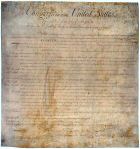 |
Bill of Rights
National Archives |
The story of Massachusetts' statehood is the story of the birth of the United States.
One of the original 13 states, Massachusetts joined the Union when it became the sixth state to
ratify the new constitution on February 6, 1788. However, Massachusetts ratified the Constitution only
on the condition that certain amendments concerning individual rights be added. These conditions, entered under
the "Bill of Rights," went into effect on December 15, 1791. |
| |
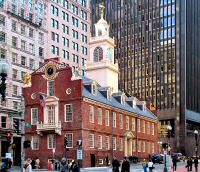 |
"Old" Massachusetts State House
dates back to 1713 |
STATE CONSTITUTION:A constitution sets out the rules by which we play the game
of government. Like the rules for any other game, it limits the moves available to players. It describes how
the various players interact with each other, and who has more power in various situations.
The Massachusetts Constitution was ratified in 1780 while the Revolutionary War was still in
progress, nine years before the United States Constitution was adopted. It is the oldest written
Constitution now in use in the world. Massachusetts, like Pennsylvania, Virginia, and Kentucky, is
called a "Commonwealth". Commonwealths are states, but the reverse is not true. Legally, Massachusetts
is a commonwealth because the term is contained in the Constitution.
PREAMBLE:The end of the institution, maintenance, and administration of government, is to secure the existence of the body politic, to protect it, and to furnish the individuals who compose it with the power of enjoying in safety and tranquillity their natural rights, and the blessings of life: and whenever these great objects are not obtained, the people have a right to alter the government, and to take measures necessary for their safety, prosperity and happiness.
The body politic is formed by a voluntary association of individuals: it is a social compact, by which the whole people covenants with each citizen, and each citizen with the whole people, that all shall be governed by certain laws for the common good. It is the duty of the people, therefore, in framing a constitution of government, to provide for an equitable mode of making laws, as well as for an impartial interpretation, and a faithful execution of them; that every man may, at all times, find his security in them.
We, therefore, the people of Massachusetts, acknowledging, with grateful hearts, the goodness of the great Legislator of the universe, in affording us, in the course of His providence, an opportunity, deliberately and peaceably, without fraud, violence or surprise, of entering into an original, explicit, and solemn compact with each other; and of forming a new constitution of civil government, for ourselves and posterity; and devoutly imploring His direction in so interesting a design, do agree upon, ordain and establish the following Declaration of Rights, and Frame of Government, as the Constitution of the Commonwealth of Massachusetts.
[ MASSACHUSETTS CONSTITUTION ] |
| |
|
STATE MOTTO:The motto of Massachusetts is attributed to Algernon Sidney, an English
soldier and politician.
The words were written in the second of two lines he wrote in The Book of Mottoes in the
King's Library at Copenhagen, Denmark around 1659.
Algernon Sidney's Discourses Concerning Government, originally published in 1698,
had some influence on political thinking at the time and may have been particularly favored by some in
the American Colonies. His words, written in The Book of Mottoes, were adopted in 1775 as an
element of Massachusetts' first colonial seal as the fledgling state began to break ties with England.
Today, those words remain as the motto of the Commonwealth. The blue ribbon
around the bottom of the shield on the coat of arms reads, Ense petit placidam sub libertate
quietem. |
| |
|
STATE GOVERNMENT:As in the case of the federal government, Massachusetts' government is
organized into three branches, as specified in its constitution - legislative, executive, and judicial.
The state government is a product of three documents: the United States Constitution, the Massachusetts
Constitution, and laws of the state.
The Governor is head of the executive branch and serves as chief administrative officer
of the state and as commander-in-chief of the Massachusetts' military forces. His or her
responsibilities include preparation of the annual budget, nomination of all judicial officers,
the granting of pardons (with the approval of the governor's Council), appointments of the heads
of most major state departments, and the acceptance or veto of each bill passed by the Legislature.
The Governor may recommend new policies for Massachusetts, new legislation, and changes in
the administration of departments that conduct the government from day to day. He or she has the power
to order out the National Guard to meet domestic emergencies and is Massachusetts' chief spokesman
with the federal government.
The Massachusetts Legislature, called the "Great and General Court," is responsible for making
the laws in Massachusetts and for raising and distributing the money necessary to run the state
government.
The Supreme Judicial Court is the highest court in the Commonwealth; it is empowered to
advise the Governor and the Legislature on questions of law. All trials are held in departments and
divisions of a Trial Court. A Trial Court hears civil and criminal cases. Cases may be appealed to the
Supreme Judicial Court or the Appeals Court for review of law. The Superior Court is the highest
department of the Trial Court. Other departments are the District, Housing, Juvenile, Land,
and Probate Courts.
[ MASSACHUSETTS GOVERNMENT ]
[ GREAT SEAL OF MASSACHUSETTS ]
[ MASSACHUSETTS STATE FLAG ] |
| |
 |
| Governor Charlie Baker |
GOVERNOR:Charles Duane "Charlie" Baker, Jr. (Republican)
FIRST LADY:Lauren Baker
[ GOVERNOR'S PAGE ]
[ FORMER STATE GOVERNORS ]
|
| |

Massachusetts State Capitol Building
"New" State House completed in 1798 |
MASSACHUSETTS CAPITOL BUILDING:
Location:Boston
Date Erected:1795-1798
- The capitol is referred to as the State House.
- Boston architect Peter Bullfinch spent months studying Greek and Roman temples. Then he adapted
their forms for this new State House, designed rows of columns, and, most daring of all, planned a
large dome. At the very top he placed a gilt pinecone as a symbol of the forests that made it
possible for the early settlers to survive.
- Governor Samuel Adams, assisted by Paul Revere, laid the cornerstone of the new State House on July 4, 1795.
- Building was placed on a hill in John Hancock's cow pasture -- Beacon Hill.
- Dome was made of wood and covered in copper by Paul Revere.
- The dome was first gilded in gold in 1861.
- Two marble wings, on either side, were added in 1917.
- During World War II, the dome was painted gray to disguise it as a landmark.
- The dome has been gilded with 23.5-karat gold leaf twice since 1948.
[ ABOUT ]
[ HISTORY ]
[ TOUR ]
[ INTERACTIVE STATEHOUSE ] |
| |
| STATE REPRESENTATION:The Massachusetts Legislature, officially referred to
as the "Great and General Court," is composed of two bodies, called houses, like the United States Congress. The two parts
are the Senate and the House of Representatives. The Legislature is referred to as a bicameral body because it
is made up of two houses. The Latin roots of the word bicameral, "bi" and "cameral," mean two chambers or rooms.
The General Court, elected every two years, is made up of a Senate of 40 members and
a House of Representatives of 160 members. Each branch elects its own leader from its
membership. The Senate elects a President and the House elects a Speaker.
[ MASSACHUSETTS GENERAL COURT ] |
| STATE REPRESENTATIVES:Representatives in Massachusetts each represent
people in a specific area of the state. These areas are called house districts. There are currently 160 men
and women representing 160 house districts in the Massachusetts House of Representatives. 23 representatives are
Republicans and 126 are Democrats. One representative is an Independent. Each representative serves for a period
of two years in the House of Representatives, after which he or she must run for re-election.
[ STATE REPRESENTATIVES ]
[ LEGISLATIVE DISTRICTS ] |
STATE SENATORS:Senators in Massachusetts each represent people
in a specific area of the state. These areas are called senate districts. There are currently 40 men and
women representing 40 senate districts in the Massachusetts Senate. Seven representatives are Republicans
and 33 are Democrats. Each senator serves for a period of two years in the Senate, after which he or she must
run for re-election.
[ STATE SENATORS ]
[ LEGISLATIVE DISTRICTS ] |
|
| |
|
LEGISLATIVE PROCESS:The legislative branch of government is responsible for making and
maintaining laws within their jurisdiction. United States representatives and senators, federal legislators,
are responsible for laws at the national level and state legislators are responsible for laws at the state
level. A law begins as an idea that is introduced in the Massachusetts General Court as a bill by one or more
legislators. Any citizen of Massachusetts may file a bill through a state legislator. The bill is assigned to
a committee, given a public hearing, and reported by the committee to the appropriate chamber with a
recommendation to pass or defeat. The bill then goes through the legislative process to become a law. During
this process the bill may be changed. Not all bills become law.
[ HOW A BILL BECOMES LAW IN MASSACHUSETTS ]
[ LEGISLATIVE TERMS ] |
| |
| CURRENT LEGISLATION:The following link will allow you to look at bills that are currently going through the
legislative process.
[ CURRENT LEGISLATION ] |
| |
| STATUTES:The following link will allow you to look at
Massachusetts's current laws.
[ THE GENERAL LAWS OF MASSACHUSETTS ] |
| |
| COUNTIES:The United States Constitution does not define local government.
Instead, this function is left up to the states.
Counties are a local unit of government within a state. All but two of the states are divided into
counties. Alaska is divided into boroughs and census districts and Louisiana is divided into parishes where
governing responsibilities are similar to counties.
Traditionally, counties performed tasks mandated by the state, such as property assessment, property and vital
statistic record keeping, maintenance of rural roads, administration of local election and judicial functions,
and support of the poor. Today, counties may be responsible for these functions, more or less, but the
responsibilities of county governments vary from state to state. The county level of government is not
mentioned in the Massachusetts Constitution and has been established by legislative action. A county
governs no area of the Commonwealth and, as is usual in New England, county government is not a strong entity.
| COUNTY TRIVIA:
- The Commonwealth of Massachusetts is divided into 14 counties
- The largest county is Worcester County at 1,513 square miles.
- The smallest county is Nantucket County at 48 square miles.
- Middlesex County is the most populated with 1,465,396 people (2000 census).
- The least populated county is Nantucket County with 9,520 people (2000 census).
[ ABOUT COUNTY GOVERNMENT ]
[ MASSACHUSETTS COUNTY GOVERNMENT ]
[ ASSOCIATION OF U.S. COUNTIES ]
[ US CENSUS BUREAU ]
[ STATE MAPS ] |
|
| |
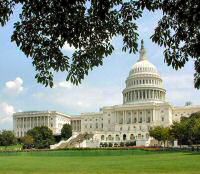 |
United States Capitol Building
Washington, DC |
U.S. CONGRESSIONAL DELEGATION:
The legislative branch of the United States government makes laws for our nation and raises and distributes
money to run the United States government. The most evident part of the legislative branch is the United
States Congress. Congress is divided into two parts, called houses. The two parts are the Senate and the House
of Representatives. Congress is referred to as a bicameral body because it is made up of two houses. The Latin
roots of the word bicameral, "bi" and "cameral," mean two chambers or rooms. Members of the Senate are called
Senators and members of the House of Representatives are called Representatives or Congressmen or women.
Senators and representatives serving in these two bodies are sometimes referred to as legislators
because their business is to legislate or make laws. The role of the legislative branch is defined in the
United States Constitution.
[ THE UNITED STATES CONSTITUTION ]
Each state elects people to represent them in the United States Congress in Washington, DC. The citizens of each
state elect two senators to represent them in the Senate. They also elect representatives to represent them in
the House of Representatives. The number of representatives each state sends to the House of Representatives
is not a specific number like the Senate, but is based on the population of the state. The people, that are
elected to represent the state's citizens in the United States Congress, are referred to as the congressional
delegation.
There are 100 senators in the U.S. Senate. Each is elected to a term, in the Senate, of six years. There are 435
representatives in the U.S. House of Representatives. Each is elected to a term, in the "House," of two
years.
The citizens of Massachusetts elect two people, like every other state, to represent them in the
Senate and 10 people, based on Massachusetts' population, to represent them in the House of Representatives.
|
| |
|
broken links to us. We really appreciate it. |
Source: State of Massachusetts Web Site, (http://www.state.ma.us), April 19, 2004
Source: Office of the Governor of Massachusetts, (http://www.mass.gov/portal/index.jsp?pageID=gov2homepage&L=1&L0=Home&sid=Agov2), April 19, 2004
Source: Massachusetts Legislature, (http://www.state.ma.us/legis/), April 19, 2004
Source: Republican Governor's Association, (http://www.rga.org), April 19, 2004
Source: National Governor's Association, (http://nga.org), April 19, 2004
Source: National Archives, (http://www.archives.gov/), April 22, 2004 |

 |
|
|
[ HOME
|| INTRO
|| SYMBOLS
|| ALMANAC
|| ECONOMY
|| GEOGRAPHY
|| STATE MAPS
|| PEOPLE
|| GOVERNMENT
]
[ FORUM
|| NEWS
|| COOL SCHOOLS
|| STATE QUIZ
|| BOOK STORE
|| MARKETPLACE
|| STATE LINKS
]
|| GUESTBOOK
|| CONTACT US
|| PRIVACY STATEMENT
] |
Site designed exclusively for NETSTATE.COM by NSTATE

NETSTATE.COM is a Trademark of NSTATE, LLC.
Copyright © 2003- by NSTATE, LLC. All rights reserved.
No copyright is claimed on non-original or licensed material.
Support NETSTATE
Top |
|